DevFlow

DevFlow

Full Stack15 January 2026

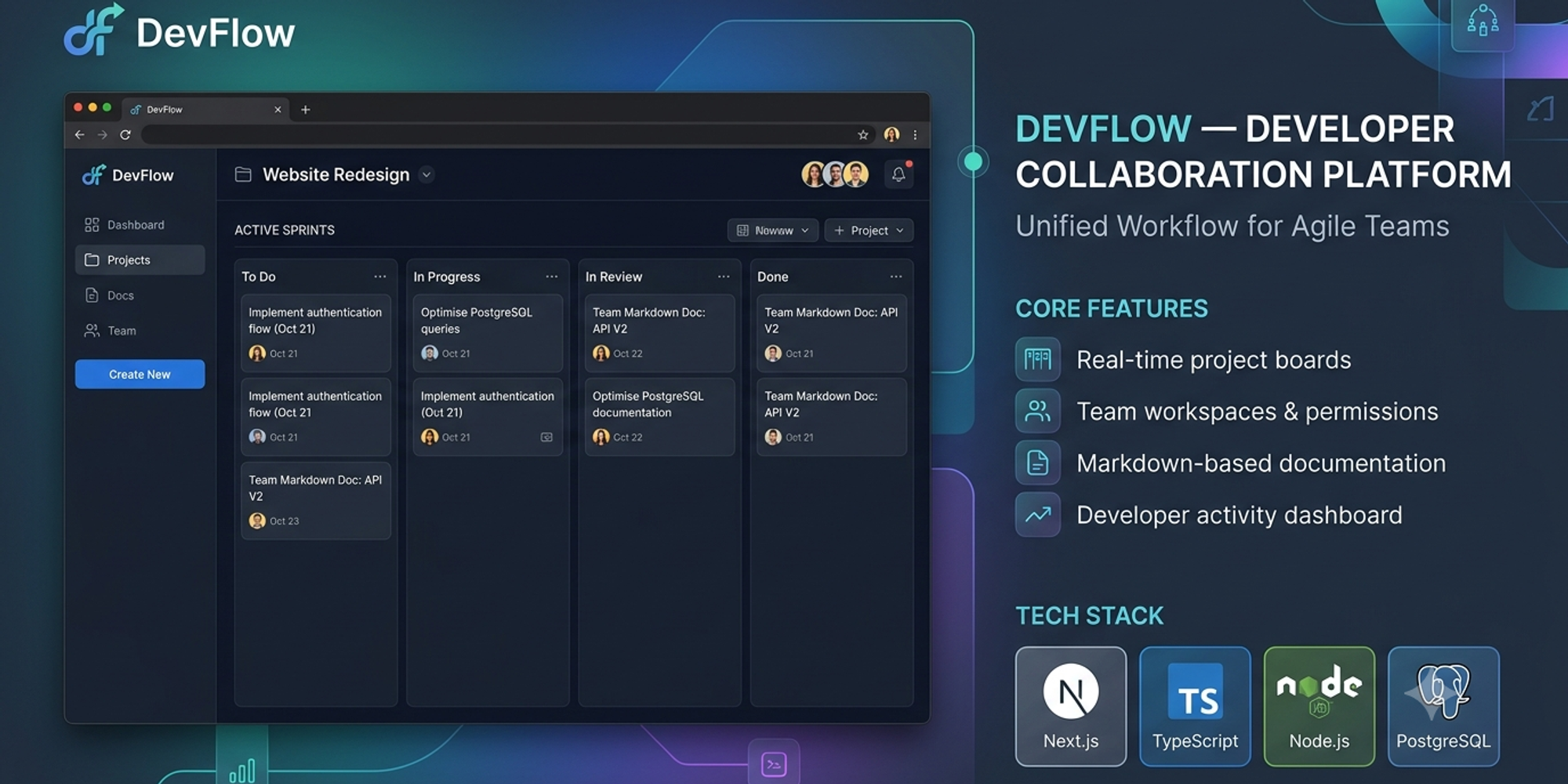
A full-stack collaboration platform that helps software teams manage projects, share knowledge and track development workflows.

NextTypeScriptNodePostgreSQL
01

The problem

Small engineering teams often rely on scattered tools for tasks, documentation and communication. Context gets lost between a task tracker, a wiki and a chat app and nobody has a single view of what the team is actually working on.

DevFlow set out to bring essential workflows into one unified platform, so a team could plan, document and ship without constantly switching context.

02

The solution

DevFlow is a modern project management application built for developers. It combines task tracking, team collaboration and technical documentation into a single workspace, with a Kanban-style board at its core and Markdown docs living right alongside the tasks they describe.

Every workspace gets its own set of projects, roles and permissions, so teams can onboard new members without exposing unrelated work.

03

My role

Designed and built the application end-to-end as the sole engineer, from the initial database schema through the deployed production app, including auth, real-time updates and CI/CD.

04

Key features

Real-time project boards

Kanban-style boards that sync instantly across every connected client using WebSockets, so status changes are visible to the whole team the moment they happen.

Team workspaces and permissions

Role-based access control lets admins scope who can view, edit, or manage each project without exposing unrelated workspaces.

Markdown-based documentation

A lightweight docs editor with live preview keeps technical documentation versioned and searchable alongside the tasks it describes.

Developer activity dashboard

A per-team dashboard surfaces recent commits, task throughput and workload distribution to help leads spot bottlenecks early.

05

Technical decisions

Chose Postgres with a normalised schema for projects, users, roles and activity events, favoring relational integrity over a document store given how interconnected the data was.

Used WebSockets for board updates instead of polling, which cut perceived latency significantly and kept the API load predictable as workspaces grew.

06

Challenges & solutions

The interesting part wasn't just building the features. It was figuring out how to make them work reliably, efficiently, and at a scale that wouldn't compromise the experience.

Challenge #1

Designing a scalable data model for projects, users, roles and activity tracking

Solution

Started with a flexible, normalised schema that separated workspace membership from project-level permissions, which made it straightforward to add new roles later without migrating existing data.

Challenge #2

Keeping real-time board updates consistent across many simultaneous clients

Solution

Introduced optimistic UI updates on the client paired with a server-side event log, so conflicting edits could be reconciled deterministically instead of relying on last-write-wins.

Challenge #3

Handling complex permission checks without making the application logic difficult to maintain

Solution

Centralised authorisation rules into reusable permission checks instead of scattering role conditions throughout the UI and API routes, making access control easier to audit and extend as new workspace and project roles were introduced.

Challenge #4

Keeping documentation, tasks and activity data fast to search as workspaces grew

Solution

Added targeted database indexes and full-text search for frequently queried fields, while keeping heavier activity queries scoped to the relevant workspace and time range so dashboards remained responsive without over-fetching data.

07

Outcome

DevFlow is used daily by a small team to plan and ship its own releases, replacing three separate tools with one workspace and giving the team a single source of truth for both tasks and documentation.

3 → 1
Tools replaced
<200ms
Board update latency
Daily, in production
Team adoption

What I learned

Centralising permission checks early paid off more than expected — every new role added later slotted into the same authorisation layer instead of requiring changes across the UI and API.

Reconciling real-time edits with an event log rather than last-write-wins was more work upfront, but it removed an entire class of "why did my change disappear" bugs that would have been painful to debug in production.

Available for work
What's next

Like what you see? There's more where that came from.

Every build starts as a rough idea and a two-line email — send yours over and let's see where it goes.